0%

Choosing China Best High School Weight Rooms for Global Buyers requires more than comparing prices or equipment lists. A suitable room should fit student age, training goals, available floor space, and the school’s supervision plan. Buyers should examine rack stability, bench adjustability, cable movement, finish quality, and clear installation documentation. Small details matter: a crowded walkway or confusing adjustment point can affect everyday use.

Youth resistance-training researcher Dr. Avery Faigenbaum is associated with the reminder, “Children are not miniature adults.” That principle matters when evaluating High School Weight Rooms. Equipment selection should reflect students’ sizes and skill levels, with adjustable settings and coach-led instruction considered alongside durability. Ask suppliers for product specifications, material details, assembly guidance, and clear warranty terms. Where possible, review samples or inspect a completed installation before placing a large order. Photos help, but they cannot show every weld, movement, or maintenance need.

Fit comes first. Then value. Global buyers also need to confirm packaging, shipping arrangements, replacement-part access, and communication across time zones. Requirements vary by school, and one layout will not suit every program. No room is perfect. Even a well-planned setup may need adjustments after students use it. That is worth admitting. A practical purchasing outline should therefore compare safety features, usability, documentation, and long-term service—not simply the number of machines. These checks give schools a clearer basis for choosing equipment that supports supervised training and daily use.
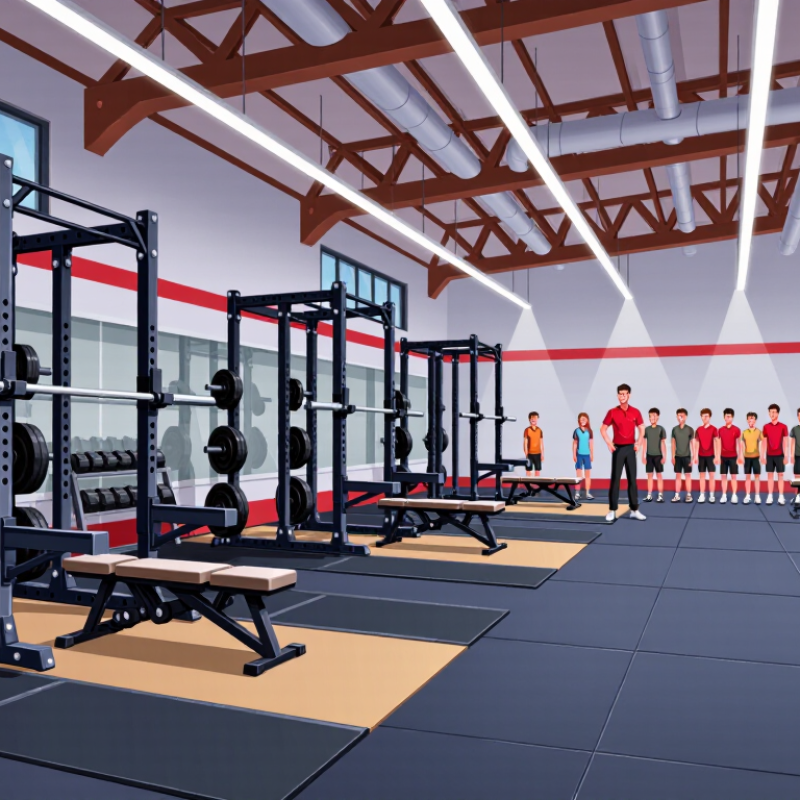
China Best High School Weight Rooms for Global Buyers

What Defines a High-Quality High School Weight Room in China

A high-quality high school weight room is designed around safe movement, not impressive equipment counts. WHO’s 2020 physical activity guidelines recommend that young people average at least 60 minutes of moderate-to-vigorous activity daily, with muscle- and bone-strengthening activity on at least three days each week. A school room should therefore support varied, age-appropriate exercises and straightforward coaching. Adjustable benches, clearly marked lifting zones, stable racks, and unobstructed walkways matter more than dense equipment placement. Small details count.

Safety depends on the room and how it is used. The National Strength and Conditioning Association’s youth resistance-training position statement emphasizes qualified supervision, appropriate instruction, and gradual progression. Buyers should check that staff can see each training station, storage does not block exits, and flooring provides firm footing around loaded equipment. Ask for installation specifications, maintenance guidance, and a practical inspection schedule. Good ventilation and enough space between stations also help students train comfortably. A checklist cannot replace competent supervision.

Specifications need testing against real school routines. Can a student adjust a bench without pinching fingers? Can staff move between stations when a class is busy? A perfect layout is rare. One overlooked issue is storage: plates left beside a rack can quickly narrow a walkway. Request a scaled floor plan, then review it with physical education staff before ordering. Consider local maintenance capacity, too; a sophisticated setup is less useful when parts or repairs are difficult to arrange.

Essential Equipment for Different School Training Needs

A school weight room should match its students, timetable, and supervision capacity. For beginners, choose adjustable benches, light dumbbells, resistance bands, and clearly marked floor space. These tools support technique practice without crowding the room. More advanced programs may add squat racks, cable stations, and bumper plates, with enough clearance for safe movement. Middle schools often benefit from flexible, lower-load stations; high schools may need durable equipment for larger training groups. The right mix matters more than a room filled with machines.

The ACSM Worldwide Survey of Fitness Trends 2025 ranked traditional strength training fifth among global fitness trends, reflecting continued demand for accessible resistance training. Equipment selection should still follow qualified coaching and gradual progression. CDC guidance recommends that young people get at least 60 minutes of physical activity daily; a well-planned weight room can support that goal, but it is only one part of school activity. Small details matter. Storage, maintenance checks, and unobstructed walkways are easy to overlook, yet they affect daily use. Some schools may also need to rethink how much floor space each station consumes.

Tips: Map student numbers and class rotations before ordering. Test bench height and rack spacing with actual users. Keep a simple inspection log, and replace worn cables or loose bolts promptly. A perfect layout is rare; review it after real classes begin.

China Best High School Weight Rooms for Global Buyers - Essential Equipment for Different School Training Needs
School Training Need Suitable Equipment Typical Users and Use Planning Considerations Safety and Maintenance
Introductory strength training Adjustable dumbbells, light fixed-weight dumbbells, resistance bands, exercise mats, and benches Students learning basic movement patterns and supervised small-group lessons Choose manageable weight increments and provide clear storage locations so students can select and return equipment easily. Teach lifting technique before increasing resistance. Inspect bands for cracks and check dumbbell handles and bench stability regularly.
Progressive barbell training Training bars, weight plates, collars, racks with safety arms, and flat or adjustable benches Students following a supervised strength and conditioning program Match bar weight and plate sizes to the students’ abilities. Allow clear access around each rack and keep plate storage close to the lifting area. Use rack safety arms set for the exercise and lifter. Train students in spotting, bar handling, and correct plate securing procedures.
Bodyweight and movement skills Pull-up or multi-grip stations, suspension-training anchors, gymnastic rings, mats, and low plyometric boxes Physical education classes, general conditioning, and movement-skill practice Check that anchoring points and overhead clearance suit the building. Select stable boxes with non-slip surfaces and appropriate heights. Securely install fixed stations according to the manufacturer’s instructions. Keep landing zones clear and supervise hanging or elevated exercises.
Cardiovascular conditioning Indoor cycles, treadmills, rowing machines, or other school-appropriate cardio equipment Warm-ups, aerobic conditioning, and individual fitness activities Select equipment based on available floor space, power requirements, intended usage, and students’ range of heights and abilities. Keep walkways clear around moving equipment. Follow maintenance schedules and teach students how to stop equipment safely.
Team-sport strength and power Racks, barbells and plates, medicine balls, resistance bands, sleds, and landing mats School teams working on supervised strength, throwing, or acceleration drills Separate lifting stations from throwing and sled lanes. Use suitable flooring and plan traffic flow for groups moving between activities. Restrict access to lifting areas during active sets. Use medicine balls and sleds only in designated spaces with adequate clearance.
Inclusive and adaptable training Resistance bands, light dumbbells, adjustable benches, accessible cardio options, and stable support bars where appropriate Students with varied experience, strength levels, and movement needs Provide more than one resistance level and consider accessible routes, transfer space, and adjustable setup options when planning the room. Adapt exercises to individual needs under qualified supervision. Keep emergency routes unobstructed and store equipment within safe reach.
Storage and room operations Plate trees, dumbbell racks, band hooks, lockable storage, wall signage, and cleaning supplies All users and staff responsible for daily setup and equipment care Store heavy items low where practical, separate equipment by type, and label storage areas to support orderly class transitions. Remove damaged equipment from service. Maintain documented inspection procedures and follow applicable local building, fire, and school safety requirements.
Equipment selection should reflect student age, training experience, supervision, room layout, and local safety requirements. This table is a general planning guide, not a substitute for professional facility design or applicable regulations.

How Global Buyers Can Evaluate Chinese Weight Room Suppliers

China Best High School Weight Rooms for Global Buyers

How Global Buyers Can Evaluate Chinese Weight Room Suppliers

A reliable supplier should explain how each item will be used, not just send a polished catalog. Ask for steel thickness, tube dimensions, coating details, and rated load for racks and benches. Request drawings with measurements, so you can check ceiling height, doorways, and training-space clearances before production.

Looks matter less. A tidy sample can still hide weak welds or unstable feet. Ask how the supplier checks weld consistency and tests finished equipment. Review dated reports and confirm which products they cover.

Compare quotations line by line. Check what is included: installation guidance, export packaging, spare parts, and warranty terms. Ask for photos of packed goods and clear carton dimensions; these affect freight planning and unloading. For a first order, consider a sample or a small batch, then inspect finish, dimensions, and assembly instructions.

Video calls can help, but they do not replace independent inspection when order value or risk is high. I would not treat one factory visit as proof of consistent quality; production can vary.

Tips: Send the same specification sheet to every supplier. Ask for written answers and lead times for replacement parts. Verify test documents with the issuing body where practical, and check local safety requirements before purchase. Keep a little doubt; it helps.

Customization, Safety Standards, and Quality Control

China’s high school weight rooms increasingly serve international education projects, where customization must support safety rather than decoration. The World Health Organization reported in 2024 that 31% of adults worldwide, about 1.8 billion people, were insufficiently active in 2022. Safe school facilities can encourage structured movement, but equipment must match student ages, body sizes, supervision levels, and available floor space.

Customization begins with practical details: rounded frames, adjustable benches, clearly marked load limits, and rubber flooring with stable shock absorption. Suppliers should reference ISO 20957 for stationary training equipment and relevant ASTM testing methods for strength and stability. A qualified factory can provide weld inspection records, material certificates, load testing, and sample approval before mass production. These documents matter more than polished product photographs.

Quality control should follow the equipment through every stage. Inspectors need to check steel thickness, bolt torque, cable routing, paint adhesion, and packaging protection. The 2024 ACSM Worldwide Survey of Fitness Trends places wearable technology among the leading industry trends, showing how measurable training is gaining importance. Schools may therefore request QR-based maintenance logs or simple usage tracking. Yet data alone cannot replace trained supervision. No factory process is perfect; rushed inspections still happen. Global buyers should require third-party verification, retain production samples, and test a complete room before shipment. Small gaps become serious when teenagers use equipment daily.

Ordering, Shipping, and Installation for International Schools

China Best High School Weight Rooms for Global Buyers

Ordering from China can reduce equipment costs, but international schools need more than a good quotation. The WHO’s 2022 Global Status Report states that 81% of school-going adolescents were insufficiently active in 2016. A properly planned weight room can support safer, regular movement during school hours. However, equipment selection must match student age, supervision levels, room size, and local safety requirements.

Request load charts, assembly drawings, test certificates, and spare-part lists before payment. ISO 20957-1 provides relevant safety principles for stationary training equipment. Ask the supplier to confirm compliance with applicable national standards, because one certificate may not satisfy every destination. Use clear Incoterms 2020 terms. Confirm whether the quote includes inland transport, export clearance, ocean freight, customs duties, insurance, and final delivery. Small omissions can become expensive delays.

Tips: Measure doorways, elevators, floor loading, and ventilation first. Send photos and a simple floor plan. For installation, require numbered cartons, bilingual instructions, torque specifications, and remote support. A local technician is safer for racks, cable systems, and flooring. Inspect every carton before signing delivery documents. Build a replacement plan for damaged parts; waiting several months can disrupt lessons. A perfect layout on paper can still fail when supervision sightlines are poor. That detail is easy to miss.

China Best High School Weight Rooms for Global Buyers: Ordering, Shipping, and Installation

This planning chart shows a neutral equipment quantity model for a 24-student international-school strength class. The quantities are calculated from practical planning ratios and exclude company or brand data.

Planning basis: one squat rack and one adjustable bench for every four students, one dumbbell pair for every two students, one lifting platform for every six students, and one storage unit for every twelve students. Final quantities should be confirmed against room dimensions, safety clearances, student age, shipping volume, and local installation requirements.

FAQS

What makes a high-quality high school weight room?

It supports safe movement, clear coaching, and age-appropriate exercises. Open walkways matter. Stable racks, adjustable benches, and marked lifting zones are essential. Equipment quantity matters less.

How should schools plan the room layout?

Begin with student numbers, class rotations, and staff visibility. Leave space between stations. Keep exits and walkways clear. Avoid crowded corners. A scaled floor plan helps staff review doorway access, ceiling height, and equipment clearance.

What safety features deserve close attention?

Use firm flooring around loaded equipment and provide good ventilation. Staff should see every training station. Storage must not block exits. Check for loose bolts, worn cables, unstable feet, and damaged padding. A checklist helps, but supervision still matters more.

Which equipment suits beginners?

Adjustable benches, light dumbbells, resistance bands, and open floor space work well. They allow technique practice with lower loads. Students can learn controlled movement before using heavier equipment. Progress should be gradual, not rushed.

What equipment may advanced high school programs need?

Advanced programs may add squat racks, cable stations, and durable plates. Provide enough clearance for lifting and movement. The equipment should match class size and supervision capacity. More machines are not automatically better.

How can schools evaluate a supplier’s equipment quality?

Request steel thickness, tube dimensions, coating details, and rated loads. Ask for measured drawings and test records. Check weld consistency and foot stability. A polished catalog proves very little. Inspect samples when possible.

What should schools compare in supplier quotations?

Compare prices line by line. Confirm installation guidance, export packaging, spare parts, warranty terms, and carton dimensions. Ask about replacement-part lead times. Small omissions can create expensive delays later.

Should a school order a large batch immediately?

A sample or small batch may be wiser for a first order. Test dimensions, finish, assembly instructions, and daily usability. Video calls are useful, but they cannot replace independent inspection for higher-risk orders. One factory visit is not proof of consistent quality.

How should the room be maintained after installation?

Keep a simple inspection log and review equipment regularly. Tighten loose bolts and replace worn cables promptly. Recheck the layout after real classes begin. Students may reveal problems that drawings missed. Perfect planning is unlikely.

Conclusion

China’s best High School Weight Rooms are defined by thoughtful layouts, durable construction, age-appropriate equipment, and a clear focus on student safety. A well-designed facility should support strength development, physical education, athletic training, and general fitness through a balanced selection of racks, benches, free weights, resistance machines, conditioning equipment, storage systems, and flooring. Equipment choices should reflect each school’s available space, student age groups, training goals, and budget while allowing future expansion.

For global buyers, evaluating Chinese suppliers requires careful review of product specifications, material quality, manufacturing experience, safety documentation, testing procedures, and quality-control systems. Buyers should also confirm customization options, installation guidance, warranty terms, packaging standards, and after-sales support. A reliable supplier can assist with layout planning, international shipping, customs preparation, and on-site or remote installation. Clear communication and documented inspections help international schools receive safe, consistent, and practical training environments that meet their operational needs.


Oliver

Oliver

Oliver is a professional marketing specialist who helps customers understand the products, services, and expertise behind our company. With in-depth knowledge of our product range and a strong understanding of customer needs, he turns complex information into clear, practical guidance. He regularly......